
How Arrest Warrants Work in Mitchell County
The legal framework comes from Iowa Code chapter 804. Under section 804.1, a criminal proceeding starts when someone files a complaint before a magistrate. If the information supports probable cause, that magistrate can issue a warrant or, in the right case, a citation instead. That call belongs to the judge or magistrate alone. The Mitchell County Sheriff serves process and does not make the probable-cause finding. Once issued, the order tells a peace officer to arrest the named person on its terms. An arrest warrant can open a new criminal case, and a later failure to appear can produce one too, under section 805.5. Read any Mitchell County warrant alongside the public complaint, docket, and orders that follow it.
Probable Cause in a Mitchell County Warrant
Probable cause is what lets a magistrate in Mitchell County issue an arrest warrant after reviewing a complaint and its supporting information. That standard is far lower than proof beyond a reasonable doubt. The public docket may show a complaint, a warrant, an initial appearance, or a later order. The affidavit underneath, though, may be limited before service or redacted for privacy and investigative reasons.
This sequence keeps the roles clear: complaint → judicial probable-cause review → warrant or citation → peace-officer service → court appearance. Mitchell County’s unified Iowa District Court handles the case record. Law-enforcement agencies handle service. A person who disputes the allegations should not try to argue the facts with a search screen or records clerk. Counsel can explain available legal options.
Arrest Warrants: What They Contain
Iowa law spells out what a warrant must contain, while public access turns on timing and confidentiality. A privacy-safe field diagram can show that structure without any real person's name, address, photograph, birth date, or case narrative. No individual Mitchell County warrant appears as an example, and none is needed to read the fields.
- Court and county
- Iowa District Court, with the county tied to the proceeding
- Case or warrant identifier
- A number used to connect the order to the docket
- Person to be arrested
- Identifying information, subject to public-access limits
- Offense or complaint
- The asserted legal basis, not a finding of guilt
- Judicial authorization
- The issuing judge or magistrate and date
- Bail direction
- Any terms in the order, which must be verified as current
A field can change when a later order is entered. Never rely on one saved view of a page to decide whether the Mitchell County arrest warrant is still active.
Mitchell County Arrest Warrant Search Limits
Iowa Courts Online offers free public case information and can surface a Mitchell County case, party, court event, citation, or payment record. It is not the Iowa On-line Warrants and Articles Criminal Justice Information Network, and it is not a live list of every active arrest warrant. Statutes limit what appears. Section 804.29 can shield information that would help secure a person under an unexecuted warrant. Chapter 232 protects juvenile material, and chapter 22 adds other confidentiality grounds. Sealed, confidential, newly issued, or recently served records may be absent or incomplete. A no-result screen is not clearance. A positive docket entry also needs current confirmation, because the court may later recall the order or record an appearance.
Key point: Public court data helps locate a case, while the clerk and responsible law-enforcement agency confirm the record’s current meaning.
How Warrants Get Served in Mitchell County
Section 804.4 lets an Iowa arrest warrant go to a peace officer for service in any Iowa county. Leaving Mitchell County for another county does not cancel the order by itself. The Mitchell County Sheriff handles local service, but city police, state officers, or another county's agency may carry it out depending on location and assignment. The Mitchell County Sheriff's Office sits at 211 South Sixth Street, Osage, Iowa 50461, phone (641) 732-4740. Its official page posts no online arrest-warrant roster, no dedicated warrant number, no surrender booking form, no after-hours procedure, and no bond-window instructions. So call first. Ask the office to identify the right service-status contact. Do not assume that walking into a general office address guarantees a safe unscheduled appearance.
Mitchell County Clerk and Sheriff Split
The Mitchell County Clerk of Court keeps the Iowa District Court file at 212 South Fifth Street, Osage, Iowa 50461, telephone (641) 732-3726. The clerk can explain public docket access, courthouse terminal access, inspection, copies, and which court a case sits in. What the clerk cannot do is give individualized legal advice.
These two Osage offices sit near each other but do different jobs. The issuing court controls judicial orders. The peace officer carries out service. Treat that two-office route as the accurate path, not the sheriff page as a missing online database for Mitchell County.
Arrest Warrants, Summonses, and Bench Warrants
Docket labels trip people up when read alone. A citation or summons can direct someone to appear without any custodial arrest. A new arrest warrant can follow probable-cause review of a complaint. A bench warrant usually describes an order issued after a missed obligation in a case already open in Mitchell County. Three forms of process, three different starting points.
| Process | Typical origin | Practical effect |
|---|---|---|
| Arrest warrant | Complaint and probable cause | Authorizes arrest by a peace officer |
| Citation or summons | Authorized alternative to custody | Directs a court appearance |
| Bench warrant | Missed date or unmet court duty | Authorizes arrest to return the case to court |
Iowa pairs the public phrase "bench warrant" with statutory arrest-warrant language. For the missed-appearance route, see the Mitchell County bench warrant lookup.
Arrest Warrants Are Not Search Warrants
An arrest warrant lets police take a named person into custody. That is its whole job. A search warrant is different: it permits a search of a place, person, or property. Iowa's official Rule 2.36 form shows the split plainly. It carries fields for the county, the court, the judge or magistrate, the criminal case number, the place or property, the command to search, an inventory, a date, and a signature. Rural Iowa courts may handle this paperwork electronically, but that convenience does not create a public arrest-warrant database. Applications and unexecuted search material can stay confidential, which keeps the two record types firmly apart. Mitchell County adds one more wrinkle. Board documents there sometimes use "warrant" to mean a payment instrument, a routine fiscal tool that has nothing to do with wanted persons.
Handling an Arrest Warrant in Your Name
Mitchell County publishes no safe-surrender form, appointment process, local bond amount, accepted bond instrument, or after-hours walk-in instructions. If a warrant might carry your name, gather the public case number and use official contacts before deciding anything. An Iowa attorney can advise on surrender, appearance, release, and challenges to the warrant.
- Search Iowa Courts Online for the available Mitchell County docket and note the latest event.
- Call the clerk to identify the issuing court and ask what public record is available.
- Speak with counsel about the safest lawful response and any bond question.
- Call the sheriff before travel when service status or agency responsibility is unclear.
- Confirm all later court action in the official record rather than assuming the warrant changed.
Act carefully: Do not ignore the record, resist service, send money to an unknown caller, or approach another person based on a warrant rumor.
Mitchell County Warrant Records Requests
A focused request under Iowa Code chapter 22 can seek an existing docket entry, order, policy, or identified record category. Give the case number, record type, custodian, and date range where you can. An office does not have to build a fresh active-warrant list, run an open-ended investigation, or reveal confidential facts. Copy, retrieval, review, redaction, supervision, postage, or programming fees may apply, and Mitchell County posts no exact fee schedule. One warning belongs here. On June 9, 2026, the Iowa Judicial Branch flagged scams that invoke unpaid fines, missed jury service, and arrest warrants. Stick to official iowacourts.gov pages and county contact information, because a caller who knows your name or case detail is not thereby trustworthy. For current Mitchell County arrest warrant status, contact the clerk or sheriff.
Official Mitchell County Sheriff Warrant Contact
The official sheriff department page is where Mitchell County posts law-enforcement contact and current service routing.
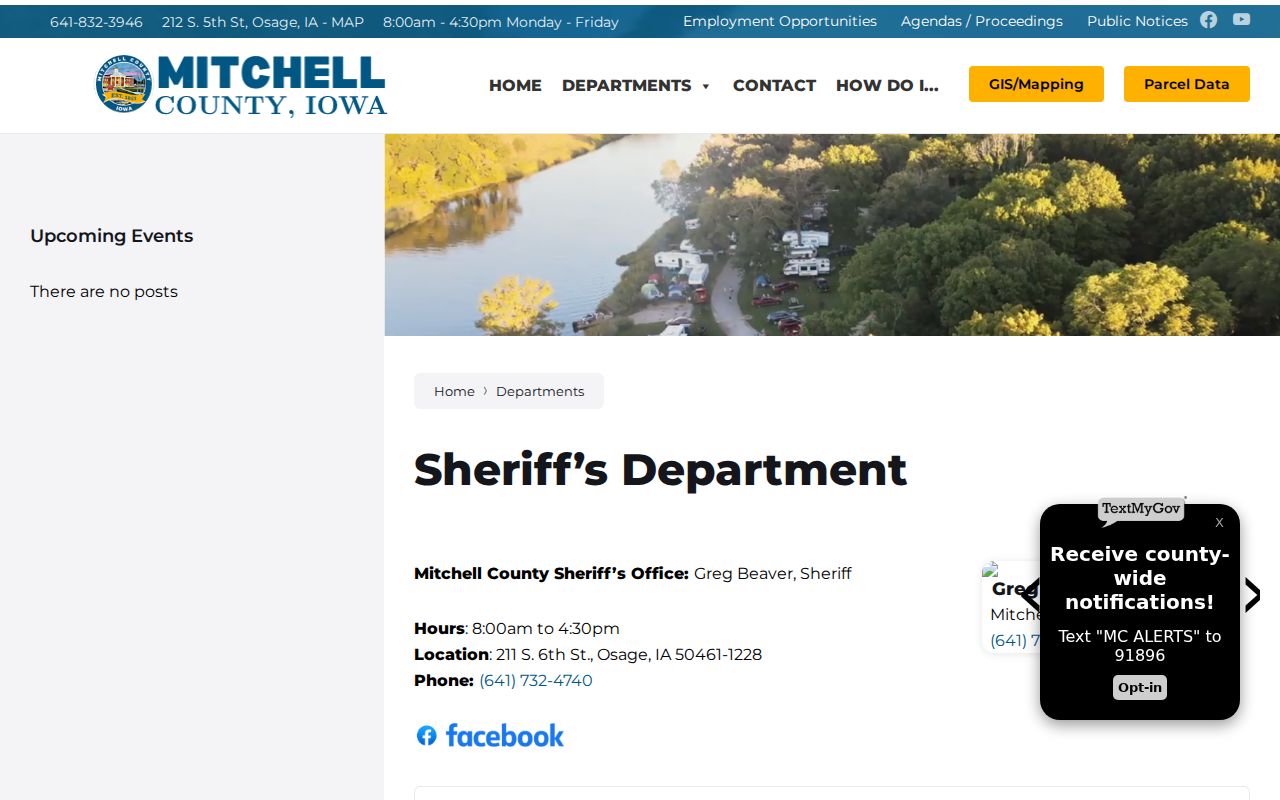
That page confirms the phone and address route for the sheriff. It shows no public arrest-warrant roster and promises no real-time warrant status.